
Fix the Cause, Not the Symptom: Three Quality Habits, Side by Side
Sorting bad parts, taping leaks, blaming operators: three quick fixes set against error-proofing, root cause work and better processes, with a short video.
Read more →News
New products, product updates, standards news and new articles from AeroQuality Insight.
Get email updates from AeroQuality Insight.
Subscribe on Gumroad ↗Sorting bad parts, taping leaks, blaming operators: three quick fixes set against error-proofing, root cause work and better processes, with a short video.
Read more →A plain-language guide to ISO 10010:2022 on quality culture. Not the standard text or a PDF. Get the standard from ISO or your national body.
Read more →A test report arrives with ISO/IEC 17025, Nadcap and AS9100 certificates attached. What each one covers, and what to ask before you accept the report.
Read more →IAQG Resolution 174 (30 June 2025) records the decision to change from multiple Standards Development Organisations to a single SDO, with all IAQG standards prefixed IA instead of AS, EN, JISQ and similar designations; it takes effect on publication of the first IAQG IA 9xxx standard, and IA-prefixed standards supersede all other versions and are to be recognized by all stakeholders in accordance with 9104/1. IAQG's announcement on SAE International as global publisher adds that new and newly revised standards use the IA prefix and that previously released standards change designation when they are revised. Organizations may wish to check the designations of the standards cited in their contracts and documented information as editions are revised.
Source: IAQG, ICOP Certification Scheme Resolutions Log (revision 14 August 2026), Resolution 174, 2026-08-14
說明航空供應商怎麼用既有的 QMS(IAQG 9100)承擔 SMS(ICAO Annex 19)的要求、通常缺在哪裡,以及面對客戶時先備妥什麼。
Read more →ISO 9001:2026 (Edition 6) was published on 2026-09-16, and Global ACI has set a three-year transition period: from 2028-03-31, new and initial accredited certifications may only be issued to ISO 9001:2026, and existing ISO 9001:2015 certificates must complete transition by 2029-09-30. Organizations may wish to obtain the standard, plan a gap analysis with their certification body, and, in aerospace, follow IAQG announcements on how the 9100 series will adopt the new edition.
Source: Global ACI, transition requirements for ISO 9001:2026, 2026-09-16
AS9100D 7.3 already requires awareness of the importance of ethical behavior and of one's contribution to product safety, and IAQG's IA9100 Key Changes (November 2023, draft stage) lists new text on quality culture and on promoting an ethical work environment, including reporting channels, investigation and no punitive action for reporting concerns. One way to put this into practice, under the guiding principle of ethics and product safety, is to let quality culture (zero defects and standards compliance, escalation of abnormalities and transparency, stop-work authority, cross-functional collaboration and continuous improvement) and ethical behavior (data integrity, whistleblower protection without fear of retaliation, avoidance of conflicts of interest and anti-counterfeit awareness, independent investigation and a just culture) support each other. On the shop floor this should be verifiable: no falsification, no concealment, willingness to call stop, and the ability to improve.
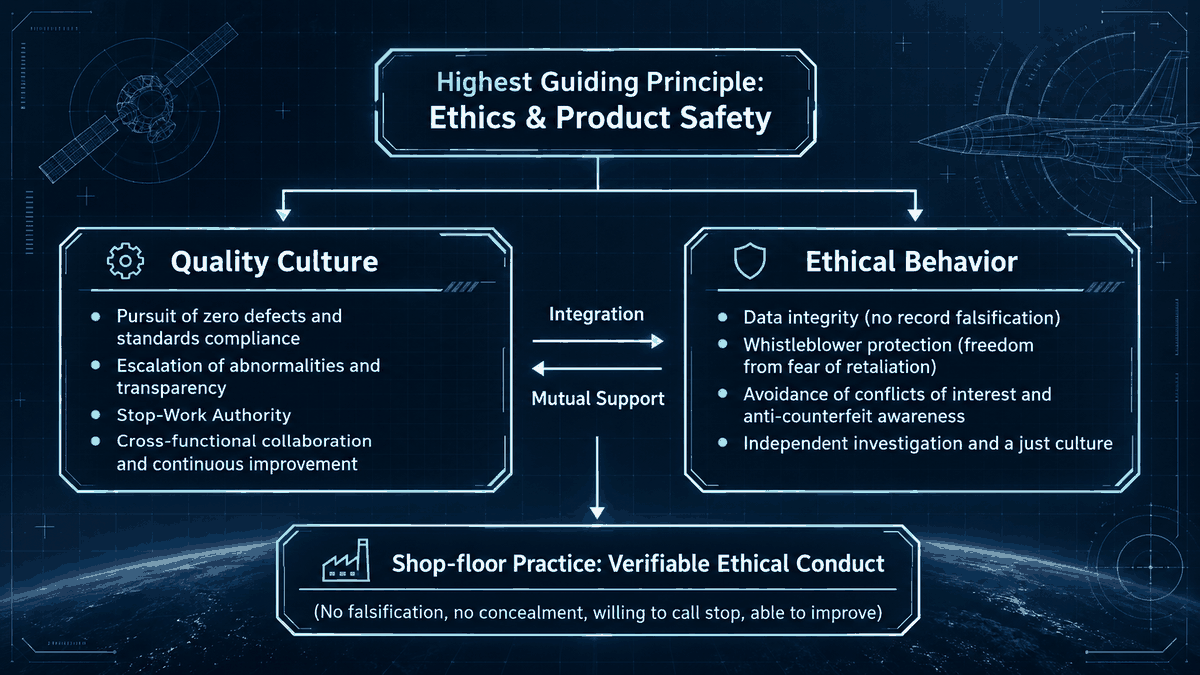
Source: IAQG, IA9100 Key Changes – System View, 2023-11
SAE AS9102C (revised June 2023, superseding AS9102B) emphasizes and enhances First Article Inspection (FAI) planning, evaluation and re-accomplishment, aligns the requirements with 9100, and rearranges some clause numbers. Key requirement changes include a documented FAI planning process with verification that planning activities are complete (4.1), a documented process to evaluate changes and decide between full and partial FAI (4.6 f), and recording of documented nonconformances through a Yes/No entry in Form 1 field 19 (4.5). On the forms, Form 1 grows from 24 to 26 fields (field 20 Verified By and field 22 Reviewed/Approved By are both required), Form 2 drops from 15 to 13 fields and Form 3 from 14 to 12, with the former signature and date fields no longer shown on those two forms; organizations may wish to check the clause and field references in their FAI procedures, FAIR forms and internal audit checklists.
Source: SAE International (AS9102C), 2023-06
SAE AS9103B (revised August 2022, superseding AS9103A) sets variation management requirements for key characteristics (KCs). It can be invoked contractually at any level of the supply chain, either stand-alone or together with other IAQG standards such as 9100, 9102, 9138 and 9145. Section 5 defines a seven-stage process model, from reviewing product KCs and preparing a control plan (CP) through trial-run data collection, measurement system analysis (MSA), control charts and capability analysis, to ongoing monitoring and process change management; where SPC is chosen, the process must be statistically stable and capable (Cpk ≥ 1.33, or as defined by or agreed with the customer). Organizations may wish to check whether customers already invoke AS9103 in contracts and compare current KC practices against it.
Source: SAE International (AS9103B), 2022-08
IAQG's November 2023 key change summary, issued at the coordination-draft stage, plans publication in 2026 alongside ISO 9001. Its main changes include product safety notes becoming requirements linked to safety management systems, a new information security requirement, APQP named as a method for operational planning, and a restructured external provider clause covering direct and sub-tier control. Final wording will follow the published standard.
Source: IAQG IA9100 Key Change Summary, 2023-11
The IAQG Meeting Week and 60th General Assembly run 12–15 October 2026. Under IA9104-1:2022, certification bodies analyze organization risk with OCAP before audits and consider the use of supporting standards when setting audit duration. Take stock of how IA9102 (FAI), IA9145 (APQP/PPAP) and IA9103 (key characteristics) are implemented and documented.
Source: IAQG, 2026-10-09
Counterfeit part prevention (AS9100D 8.1.4), requirements flow-down on purchase orders (8.4.3) and calibration acceptance for measurement traceability (7.1.5.2), each with a fictional worked example and audit questions.
Read more →A practical field guide from disruption to verified recovery: 7 parts, 18 chapters, a worked aerospace machining case and 7 blank forms. English EPUB, US$20.
Read more →A 310-page practical AS9100D guide in 6 parts and 50 chapters, with 14 procedure templates, 20 form templates and 144 audit questions. PDF, US$29, V1.0. (Published in Traditional Chinese.)
Read more →Launched on 1 Oct 2026 and no longer offered. It was a professional work system that connected impact analysis, dependencies and recovery decisions. V1.0, US$79 (no longer offered).
Successor: Business Continuity Plan: A Practical Field Guide →
Read more →For teams moving from automotive to aerospace: start with a free transition diagnostic, then move to a professional implementation work system. US$79, V1.0 Professional Bundle.
Read more →60 process-based audit questions, objective evidence guidance, risk-based sampling, CAPA follow-up and editable Excel audit tools. Launch price US$79, V1.3 Final Commercial Release.
Read more →Covering internal audit effectiveness, supplier approval risk, management review, nonconforming output control, first-piece inspection evidence, procedure-to-shop-floor verification and procedure design for audit conformity.
Read more →The Suite: two printable PDF handbooks, an ISO 9001:2026 assessment checklist and an ISO 19011 comparison matrix, 82 pages, US$49. The Guide: quality culture implementation with a manufacturing case study, diagnostic tools and a Just Culture policy template, PDF, US$19.
Read more →ISO has published ISO 9001:2026, Quality management systems — Requirements. A practical interpretation is available in the knowledge hub.
Source: ISO news release, 2026-09-16
Read more →