
External testing laboratories
A Lab Has the Certificates. Can You Accept the Test Report?
An outsourced material test report comes back with the lab's certificates attached, and the usual check is whether they are in date. That check is fine, but a certificate often proves less than it looks like. From a buyer and quality point of view, this note explains what ISO/IEC 17025, Nadcap and AS9100 each cover, and seven questions worth asking before you accept the report.
Three certificates, three different jobs
Start with ISO/IEC 17025 capability. It asks whether the lab can run the tests properly: people, equipment calibration, methods, records and reporting. Nadcap accreditation for materials testing laboratories builds on ISO/IEC 17025 and adds test-specific requirements for each test category. The most visible one is proficiency testing: the lab regularly tests the same samples as its peers and compares results. Customer requirements sit on top. When they are in writing, they take precedence over the Nadcap criteria.
The AS9100 certificate is a separate thing. It covers the management system only, and conformity to 9100 does not by itself show that a lab can do the testing. The certificate on the wall tells you the lab runs documentation, audits and corrective action. It's best not to use it as evidence of testing capability. The two are easy to mix up.
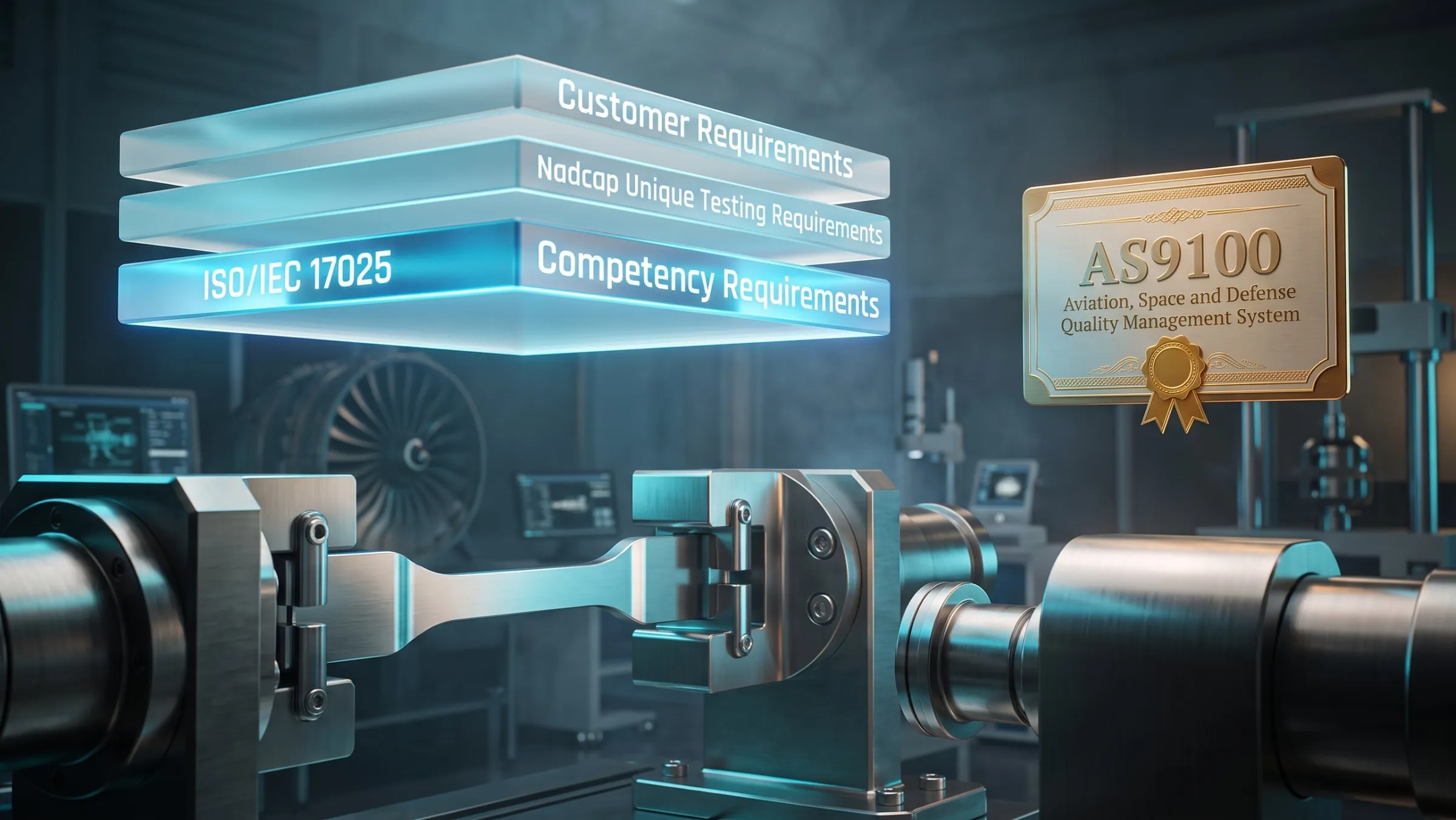
Figure: Three layers of assurance for an external testing laboratory, and where AS9100 sits
Read the scope first
Nadcap accreditation is granted by test category. Chemical analysis, tensile, metallography and hardness each have their own test codes. A lab accredited for hardness isn't automatically accredited for fatigue. When a report comes in, open the certificate scope first and look for the test you ordered.
Take chemical analysis. Alloying elements such as titanium, aluminum, nickel and chromium are usually measured by spark optical emission (OES) or inductively coupled plasma (ICP). Carbon, sulfur, oxygen, nitrogen and hydrogen are measured by combustion or fusion methods, on different equipment. Nadcap AC7101/14 Rev. NA (2023-09-06 edition) lists the two groups separately, so a chemistry lab may have the spectrometry codes without the combustion or fusion ones. If your order calls for oxygen, nitrogen or hydrogen, confirm that item is in scope.
Tensile testing works the same way. Room temperature and elevated temperature are separate items, and creep and stress rupture are separate again.
Proficiency testing: customers differ
Nadcap requires proficiency testing, and how often depends on the test category: every 2 years for chemical analysis, tensile and hardness, every 5 years for fatigue and fracture toughness. For compression, impact and bend testing, AC7101/14 requires neither proficiency testing nor an internal round robin, so there is no such record to look at. You will need other evidence. Also, a PT record only shows that the lab has compared itself with its peers. It doesn't guarantee every test was sound. Treat it as supporting information, not a conclusion.
The provider matters too. AC7101/14 splits customers into two approaches. Some aerospace customers ask for a PRI-recognized provider and allow a step down only when none is available. Other customers, if they name none, accept a provider approved by the Nadcap Materials Testing Laboratories Task Group (MTLTG), or an ISO 17043-accredited provider. The same PT record may be enough for one and not for the other. Which one applies to you? Asking your customer is the surest way to find out.
Where the customer or purchase order says something specific, follow that, and treat the certificate as supporting evidence.
Questions worth asking before acceptance
Check
- Is the test I ordered within the certificate scope? Check it against the test code.
- Has our customer specified a proficiency test provider?
- When was the last proficiency test, and were the results within range?
- If an internal round robin is required for that test, how is it run? Are all operators and machines covered?
- Was any of this work sent to another lab? If so, did the customer know and agree?
- When the report says "conforms to specification", what decision rule was used?
- If something goes wrong during testing, does the lab notify the customer and look back at earlier results?
How to decide once you have the answers
Once you have the answers, should you accept? Here is one way to decide:
- Scope does not match. Hold acceptance for now. If the test isn't in the scope, no number of other certificates can show the lab is capable of that test.
- Scope matches, customer requirements not yet confirmed. Ask first. Confirm the proficiency test provider and what the report must contain, then release.
- Scope, customer requirements and records all line up. You can consider accepting. The inspection and record requirements in the purchase order continue as usual, including any sampling checks.
Key point
Certificates get you part of the way. Someone still has to read the scope, the customer requirements and the records, and that step is worth keeping.
About this article
This article is general information for aerospace quality professionals. It is not an official interpretation of any standard and does not replace the standard, customer requirements or your own procedures. Not affiliated with or endorsed by SAE, IAQG or ISO.
Last updated: 2026-10-22
Get email updates from AeroQuality Insight.