Inputs & Outputs
Define what initiates the process and what deliverable, decision or record exits the process.
 AeroQuality Insight
AS9100 / PROCESS APPROACH
In an Aviation, Space and Defense Quality Management System, the process approach is the foundation for systems thinking, value creation and evidence-based evaluation.
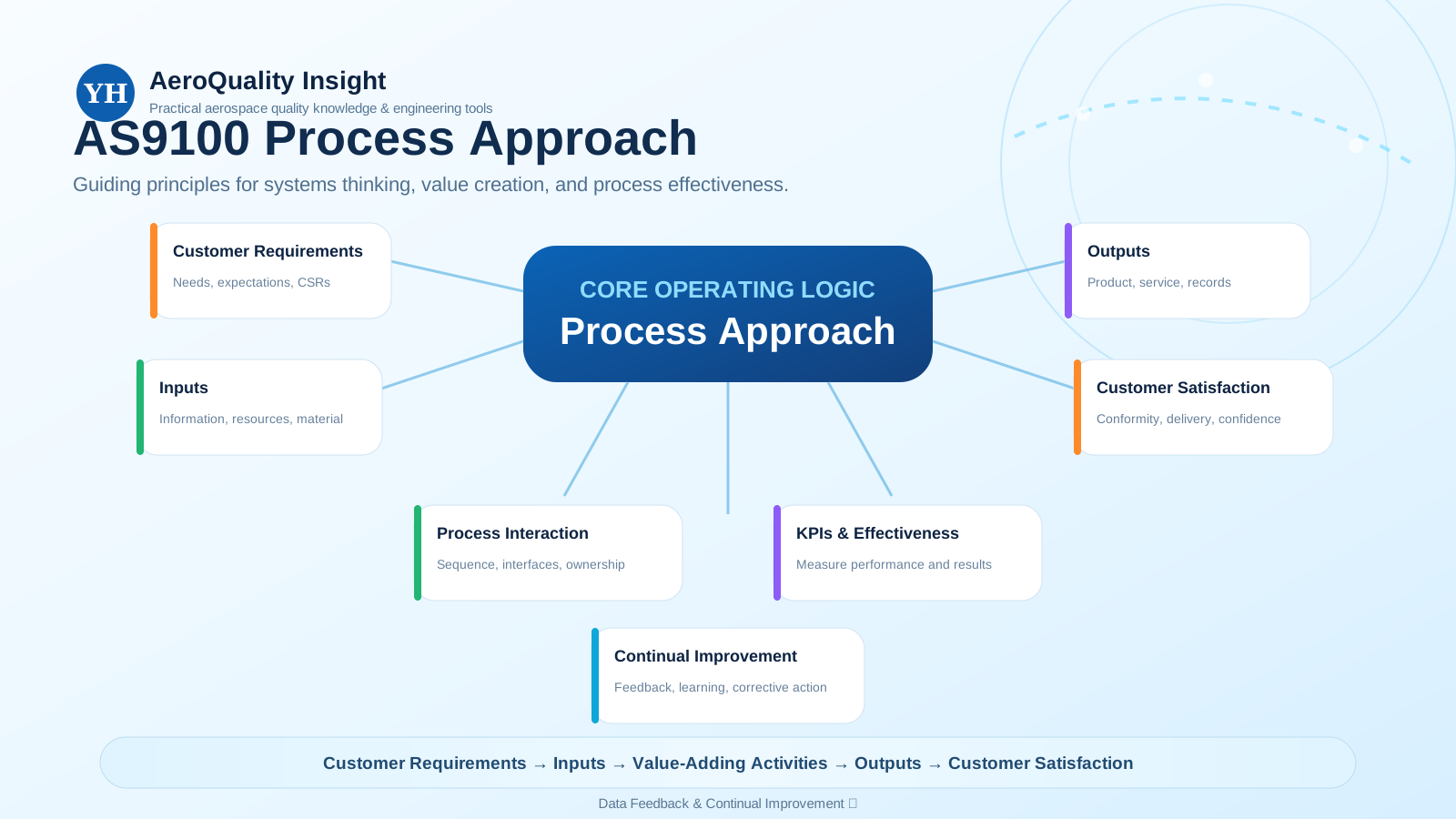
1. FUNDAMENTAL CONCEPT
The process approach systematically identifies and manages interactions among organizational activities so that inputs are transformed into predictable outputs. Customer requirements represent an expectation that has not yet been fulfilled; controlled processes convert those expectations into conforming products and services.
Data Feedback & Continual Improvement ↺ feeds performance information back into the system.
2. PROCESS ARCHITECTURE
Product realization is a multi-functional system. Procurement, engineering, production, inspection, logistics and supporting activities are more effective when managed as an end-to-end process flow rather than as isolated departments.
A useful architecture separates macro-level process models from micro-level execution controls.
3. SEQUENCE & INTERACTION
Once a process is identified, its boundaries, inputs, outputs, resources, methods, ownership and performance measures should be visible. A Turtle Diagram is one practical way to organize those relationships; the tool itself is not the requirement.
Define what initiates the process and what deliverable, decision or record exits the process.
Identify facilities, hardware, software, tooling, data and materials required for controlled execution.
Define process ownership, operator responsibilities and the competence necessary to perform the work.
Connect procedures, work instructions, specifications and acceptance criteria to the actual operating steps.
Use quantitative measures to evaluate performance, effectiveness and, where useful, efficiency.
Integrate production control, inspection, calibration, risk mitigation and change control into the process system.
Verify that one process output is suitable and controlled when it becomes the next process input.
Retain sufficient records and data to demonstrate implementation, conformity and process effectiveness.
4. PROCESS HEALTH SELF-EVALUATION
Is the process clearly bounded? Are inputs, outputs, resources and control gates defined?
Who are the internal and external customers? Are applicable customer-specific requirements reflected in the process?
Are process owners and operators assigned, and is required competence demonstrated?
Is the process consistently operating according to its intended architecture and controls?
Are targets and KPIs defined, supported by reliable data collection and analysis?
When performance misses the target, are causes evaluated, actions implemented and effectiveness reviewed?
OPERATIONAL MANAGEMENT FOCUS
Process management becomes meaningful when customer performance, leadership engagement, QMS health, change control and continual improvement are evaluated together rather than as separate compliance topics.
CORE TAKEAWAY
A mature process is not defined only by a procedure. It has a purpose, owner, input, output, resources, controls, interfaces, measures and evidence — and it is continually adjusted using performance feedback.
Customer Need → Process Architecture → Controlled Execution → Evidence → Performance → Improvement
NEXT STEP
Use the free starter sheet to connect process intent, ownership, risk, controls, objective evidence and audit questions in one working structure.
FROM KNOWLEDGE TO PRACTICE
Connect process ownership and interfaces with audit questions, traceable evidence and follow-up using a reusable AS9100D audit workbook.
Independent professional audit toolkit · Editable Excel · English + Traditional Chinese
Explore the AS9100D Audit ToolkitPrefer to study AS9100D first? AS9100D in Practice is a practical guide from requirements to objective evidence, published in Traditional Chinese.
Get email updates from AeroQuality Insight.